
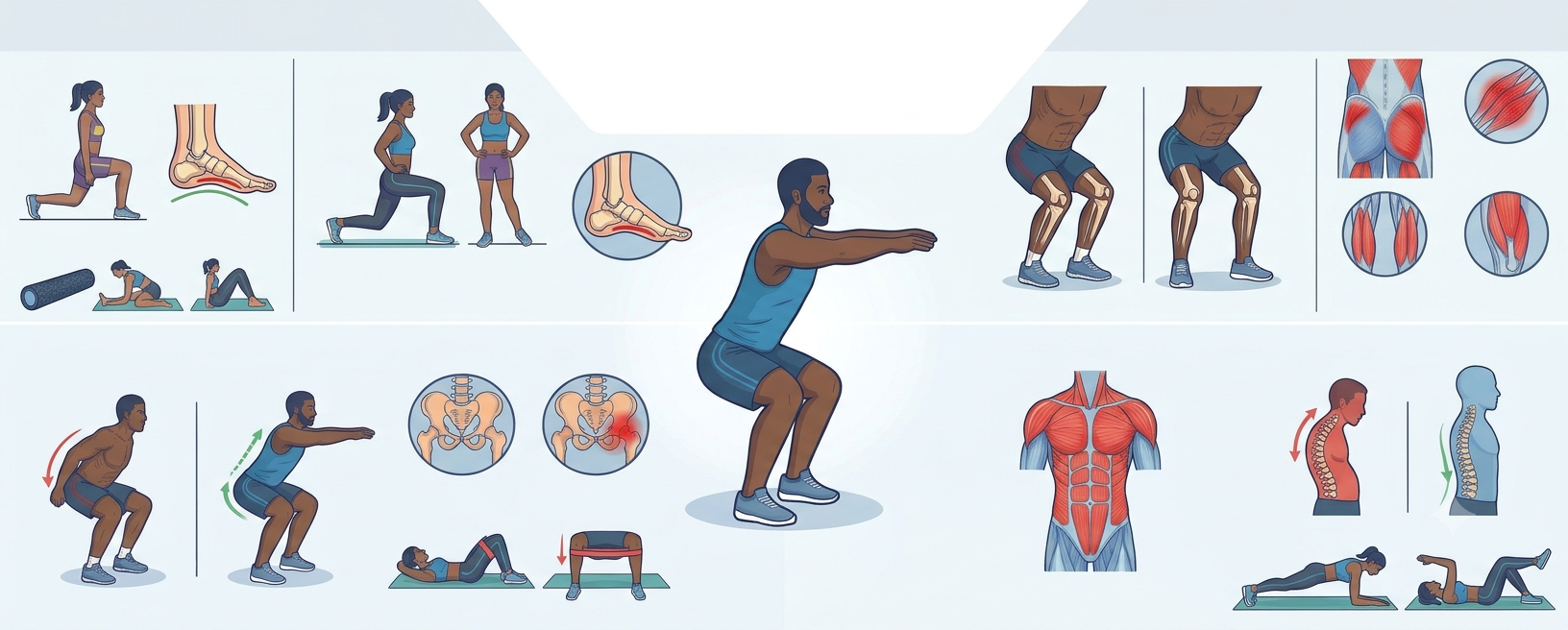
Want to improve your squat but aren't sure where to start? Whether you're struggling with squat depth, feeling unstable, or experiencing discomfort, the answer may lie in how your body moves.
Learning how to improve your squat starts with understanding four key areas: ankle mobility, knee control, hip movement, and core stability.
The goal isn't necessarily to squat deeper or keep your torso perfectly upright. It's to develop a squat that feels comfortable, controlled, and appropriate for your body.
Why Squatting Matters
Squatting is one of the most fundamental movement patterns we use in everyday life. From getting out of a chair to picking something up off the floor, the ability to squat comfortably plays an important role in maintaining strength, mobility, and independence.
Improving your squat form can help you:
- Build lower-body strength and stability.
- Improve mobility and movement control.
- Support balance and coordination.
- Perform everyday activities with greater confidence.
- Develop better movement efficiency during exercise.
However, factors such as limited ankle mobility, hip restrictions, muscle weakness, and previous injuries can influence how you squat.
Understanding these limitations is the first step toward improving your movement.
Proper Squat Form Looks Different for Everyone
There's no single perfect squat technique that works for everyone.
Your hip anatomy, limb proportions, mobility, strength, and training goals all influence how your squat looks and feels.
For example, someone with longer femurs may naturally lean farther forward, while another person may maintain a more upright torso. Neither position is automatically incorrect.
The key is finding a squat position that allows you to maintain balance, control, and comfort throughout the movement.
Where Should Your Feet Be When Squatting?
A good starting point is to position your feet approximately hip- to shoulder-width apart, with your toes slightly turned outward.
From there, make small adjustments based on what feels most natural.
Pay attention to whether you can:
- Keep your feet firmly planted.
- Maintain balance throughout the movement.
- Move your knees comfortably in line with your feet.
- Lower into a comfortable range without pain.
Your stance should support your body's natural movement rather than force you into a specific position.
Four Key Checkpoints to Improve Your Squat Form
Improving squat technique isn't about correcting every detail at once. It's about identifying which areas may be limiting your mobility, stability, or control.
Start with these four checkpoints.
1. Feet and Ankles: Build a Stable Foundation
Your feet and ankles provide the foundation for your squat.
Adequate ankle mobility allows your knees to move forward as you lower into the squat while helping you maintain balance and keep your heels grounded.
Limited ankle mobility may contribute to:
- Heels lifting off the floor.
- Difficulty reaching a comfortable squat depth.
- Shifting weight excessively toward your toes.
- Changes in balance or squat mechanics.
Squat form tip: Keep your weight distributed across three points of contact: your heel, the base of your big toe, and the base of your little toe.
This creates a stable foundation while allowing your foot to move naturally.
If your heels consistently lift or you struggle to maintain balance, ankle mobility may be one area worth assessing.
Related reading: Learn more about flat feet and arch support.
2. Knees: Focus on Control, Not Restriction
One of the most common misconceptions about squatting is that your knees should never move past your toes.
In reality, allowing your knees to travel past your toes is a normal part of many squat movements and isn't inherently harmful.
The amount of forward knee movement depends on your anatomy, squat depth, stance, and training goals.
Instead of restricting knee movement, focus on maintaining control throughout the exercise.
Squat form tip: Allow your knees to move naturally in the direction of your toes as you lower into the squat.
Avoid forcing them into a rigid position. The goal is to maintain comfortable, controlled movement rather than follow an overly restrictive rule.
If you experience persistent knee discomfort while squatting, a physical therapist can help identify contributing factors such as mobility limitations, strength deficits, or load tolerance.
3. Hips: Improve Mobility and Movement Control
Your hips play a major role in squat depth, stability, and overall movement efficiency.
Limited hip mobility or reduced strength can affect how comfortably you lower into a squat and maintain control throughout the movement.
However, not every limitation in squat depth is caused by tight hips. Individual anatomy, balance, and strength also influence your available range of motion.
Squat form tip: Experiment with small adjustments to your stance width and toe position to find a comfortable range of motion.
Focus on lowering with control rather than forcing yourself into the deepest possible position.
Building hip strength and improving mobility where needed can help support more comfortable, efficient squatting.
Related reading: Explore our guide to healthy hips for athletes.
4. Pelvis and Core: Create Stability Throughout the Movement
Your core helps stabilize your trunk and support controlled movement as you squat.
Without adequate core control, maintaining balance and managing heavier loads may become more challenging.
Core stability doesn't mean keeping your spine or pelvis completely rigid. Your body should still be able to move naturally throughout the exercise.
Squat form tip: Before lowering, gently brace your abdominal muscles as though you're preparing for a light punch to the stomach.
Maintain steady tension around your midsection while breathing and allowing your hips and pelvis to move comfortably.
This helps create a stable foundation for the movement without unnecessary stiffness.
How to Improve Your Squat Technique
Once you've assessed these four checkpoints, focus on making small, intentional adjustments rather than changing everything at once.
Here are a few practical ways to improve your squat:
- Start with bodyweight squats. Practice controlling the movement before adding external resistance.
- Adjust your stance. Experiment with foot width and toe positioning to find what feels comfortable.
- Work within your available range. Focus on maintaining control rather than forcing additional squat depth.
- Address mobility limitations. If ankle or hip restrictions affect your movement, targeted mobility exercises may help.
- Progress gradually. Increase resistance or squat depth as your strength, comfort, and control improve.
Remember, improving squat form takes consistency. Small adjustments made over time can help you develop greater confidence in your movement.
When Should You See a Physical Therapist for Squat Pain?
Occasional difficulty with squat technique doesn't always mean something is wrong. However, persistent discomfort or difficulty progressing may indicate that a more individualized assessment would be helpful.
Consider seeing a physical therapist if you:
- Experience recurring knee, hip, ankle, or back pain while squatting.
- Struggle to maintain balance or control despite adjusting your technique.
- Notice significant differences in strength or mobility between sides.
- Have difficulty returning to squatting after an injury.
- Cannot progress comfortably despite consistent practice.
A physical therapist can evaluate your mobility, strength, movement patterns, symptoms, and training goals to help identify the factors affecting your squat.
At Iron Health Physical Therapy, our one-on-one orthopedic physical therapy sessions focus on understanding how your body moves and developing an individualized approach to improving function and managing pain.
For those looking to build strength and improve exercise technique, our small group personal training sessions also provide professional coaching and real-time movement guidance.
Related reading: The Five Pillars of the Squat.
Frequently Asked Questions About Squat Form
Should my knees go past my toes when I squat?
Yes. Your knees can naturally travel past your toes during a squat, depending on your mobility, anatomy, and movement pattern.
This isn't inherently harmful. Rather than restricting knee movement, prioritize comfort, control, and appropriate loading.
If forward knee movement consistently causes pain, consider having your squat mechanics assessed by a physical therapist.
Why does my squat look different from someone else's?
Everyone has different limb proportions, hip anatomy, mobility, and strength levels.
These differences influence stance width, torso positioning, and squat depth. A squat that works well for one person may not be ideal for another.
Focus on developing a squat that supports your individual movement needs and goals.
Why can't I squat deeper?
Difficulty reaching a deeper squat may be related to limited ankle or hip mobility, muscle strength, balance, movement control, or individual anatomy.
Try adjusting your stance or reducing your squat depth to maintain better control.
Avoid forcing a deeper position if it causes pain. A physical therapist can help identify which factors may be limiting your movement.
How can I improve ankle mobility for squats?
Start by observing how your ankles move during a bodyweight squat.
If your heels lift or your balance shifts as your knees move forward, limited ankle mobility may be contributing to the movement.
Gentle ankle mobility exercises may help, but the most effective approach depends on the underlying limitation.
A physical therapist can determine whether mobility, strength, or movement control should be your primary focus.
Is it okay if squatting hurts?
Squatting shouldn't require you to push through persistent or worsening pain.
If you experience discomfort, consider reducing the load, adjusting your squat depth, or temporarily modifying the exercise.
Persistent pain should be evaluated by a healthcare professional. Severe pain or significant loss of function warrants prompt medical attention.
Improve Your Squat With Personalized Guidance
Learning how to improve your squat starts with understanding how your body moves.
By paying attention to ankle mobility, knee control, hip movement, and core stability, you can begin identifying areas that may benefit from additional attention.
Remember, the goal isn't to achieve someone else's version of a perfect squat. It's to build strength, mobility, and confidence in a movement pattern that works for you.
If you're experiencing pain, struggling with squat depth, or looking to improve your technique, Iron Health Physical Therapy can help.
Our physical therapists provide individualized assessments to identify movement limitations and develop a plan tailored to your goals.
Ready to move better? Book an appointment or try personal training to take the next step toward stronger, more confident movement