
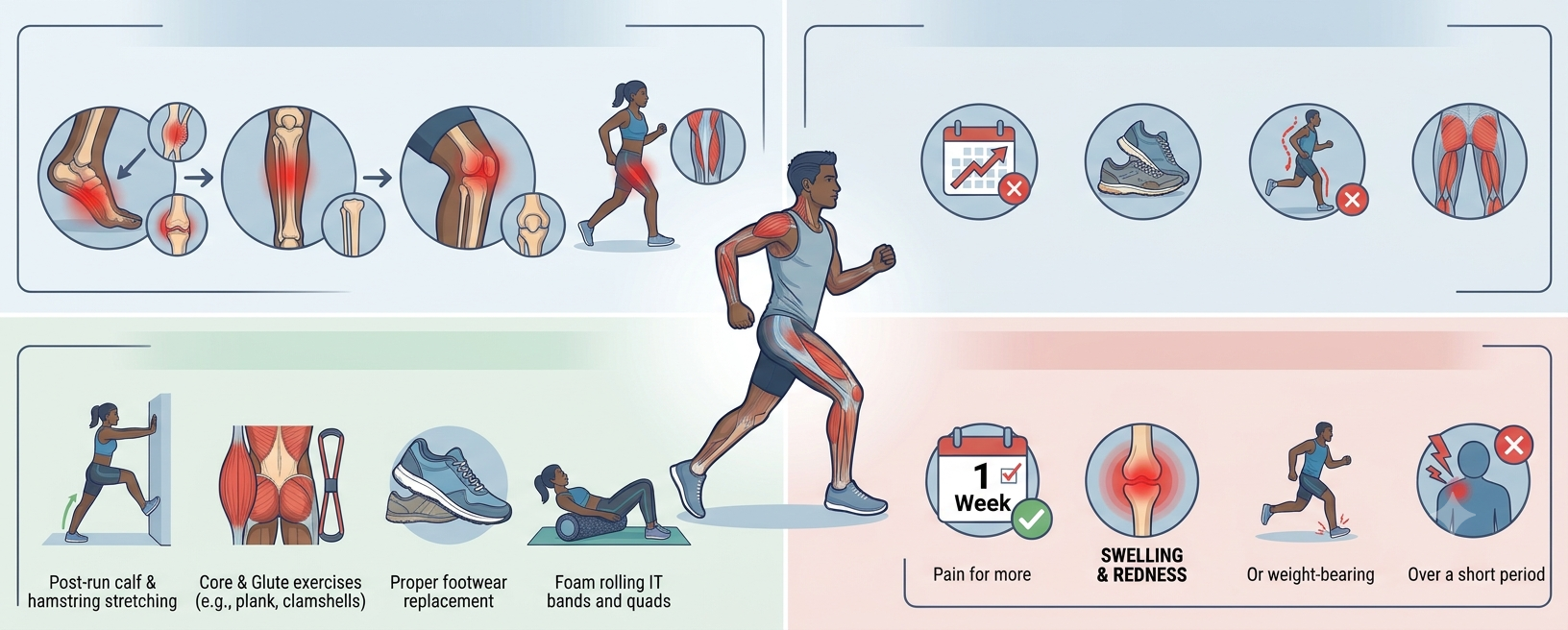
Pain while running can affect your knees, hips, ankles, or feet, and it doesn't always have one clear cause. Training load, recovery, strength, running mechanics, and previous injuries can all influence how your body responds to running.
The right approach depends on where the pain occurs, when it starts, and how it changes throughout your run. Understanding common contributing factors can help you make appropriate training adjustments and recognize when it's time to seek guidance from a physical therapist.
Why Running Hurts More Than Walking
Running places greater demands on your body than walking because you spend part of each stride airborne before repeatedly landing on the ground. The amount and distribution of force depend on factors such as your speed, stride, running surface, and individual movement patterns.
Your muscles, tendons, bones, and joints work together to manage these demands. When your training intensity or mileage increases faster than your body can tolerate, or when recovery is insufficient, discomfort and running injuries may develop.
However, impact alone doesn't explain every running injury, and experiencing pain doesn't automatically mean your running technique is incorrect.
The Over-Striding Problem
Over-striding occurs when your foot lands relatively far ahead of your body's center of mass. Depending on your speed and running mechanics, this can increase braking forces and change how stress is distributed across your lower body.
However, landing heel-first doesn't necessarily mean you're over-striding. Foot-strike patterns vary between runners, and heel striking alone isn't a sign of poor technique or an increased injury risk.
If you regularly experience pain while running, a physical therapist can evaluate your stride alongside your strength, mobility, training history, and symptoms.
The goal is to identify adjustments that support your individual movement patterns rather than force every runner into the same running style.
Three Ways to Reduce Running-Related Stress
1. Land Closer to Your Body
Pay attention to where your foot lands in relation to your body. Landing excessively far ahead of your center of mass may increase braking forces and affect how your lower limbs absorb impact.
Running tip: Focus on taking comfortable, controlled steps rather than reaching forward with each stride.
Avoid forcing a particular foot-strike pattern, as changes to your running mechanics should reflect your individual needs and comfort.
2. Adjust Your Running Cadence
Running cadence refers to the number of steps you take per minute. In some runners, a modest increase in cadence can help reduce over-striding and change how forces are distributed across the lower body.
To measure your cadence, count how many times your right foot contacts the ground in 30 seconds, then multiply that number by four.
For example, if you count 40 contacts, your cadence is approximately 160 steps per minute.
Although 180 steps per minute is commonly referenced as an ideal cadence, there is no universal target for every runner. Your optimal cadence depends on your speed, body proportions, and running experience.
Running tip: If adjusting your cadence is appropriate, start with small changes rather than trying to reach a specific number immediately. A playlist with a consistent tempo can help you practice.
3. Manage Your Weekly Mileage
Increasing running mileage too quickly can place additional demands on your muscles, joints, and connective tissues.
Two commonly used training guidelines include:
- The 10% rule: Increase your total weekly mileage by no more than approximately 10%. For example, if you run 10 miles this week, your next week might total around 11 miles.
- Long-run distribution: Keep your longest run around 30% of your total weekly mileage. For someone running 10 miles per week, that would be approximately 3 miles.
These are general guidelines rather than strict injury-prevention rules. Your training progression should reflect your fitness level, recovery, and individual tolerance.
Include rest or active-recovery days throughout your training schedule, and adjust your workload if you notice persistent discomfort or unusual fatigue.
When to Get Help for Pain While Running
If your running pain persists, worsens, or begins affecting your stride, consider scheduling an evaluation with a physical therapist or your primary care physician.
A physical therapist can assess your movement patterns, strength, mobility, training history, and symptoms to identify factors that may be contributing to your discomfort.
At Iron Health Physical Therapy, our orthopedic physical therapy services focus on individualized assessments and treatment plans designed to help you move comfortably and return to the activities you enjoy.
Depending on where your symptoms occur, you may also benefit from learning more about:
- Hip health for athletes: Understanding how hip strength and mobility influence movement.
- Knee rehabilitation: Addressing persistent knee discomfort and improving lower-body function.
- Flat feet and arch support: Exploring how foot mechanics may influence your running experience.
Seek urgent medical care if you experience sudden severe pain, an inability to bear weight, significant swelling following an injury, visible deformity, or new numbness or loss of function. Avoid continuing to run when these symptoms are present.
Frequently Asked Questions About Running Pain
Why do my knees hurt when I run?
Knee pain while running can result from several factors, including changes in training load, irritated tissues, strength limitations, movement mechanics, or previous injuries.
Over-striding may influence how forces are distributed across your knees, but it isn't the only potential cause.
If knee pain persists or changes how you run, a physical therapy assessment can help identify contributing factors and appropriate next steps.
What is a good running cadence?
There is no single ideal running cadence for everyone. Your cadence depends on factors such as running speed, body proportions, and experience.
Although 180 steps per minute is frequently mentioned as a target, it shouldn't be treated as a requirement.
A physical therapist can help determine whether adjusting your cadence may benefit your running mechanics or symptoms.
How quickly should I increase my running mileage?
Increase your mileage gradually based on your current fitness level, recent training workload, and recovery.
The 10% rule is a commonly used guideline, but it isn't a universal threshold for preventing running injuries.
Pay attention to recurring pain, unusual fatigue, and changes in your movement patterns, and adjust your training when necessary.
Should I stop running if it hurts?
Avoid pushing through pain that is sharp, persistent, worsening, or affecting your running mechanics.
Reducing your mileage, adjusting your intensity, or temporarily pausing the activity may be appropriate while you determine what's causing your symptoms.
If discomfort continues, seek professional guidance. Severe pain or significant loss of function warrants prompt medical attention.
Can physical therapy help with running injuries?
Yes. Physical therapy can help identify factors contributing to running-related pain and guide rehabilitation or a gradual return to running.
An assessment may include evaluating your strength, mobility, running mechanics, training history, and symptoms.
Treatment recommendations are individualized, as no single exercise or running technique works for every runner.
Get a Running Evaluation at Iron Health Physical Therapy
Experiencing pain while running doesn't automatically mean your technique is incorrect, but it may be a sign that your body needs additional attention.
Adjusting your training workload, reviewing your running mechanics, and allowing adequate recovery can help manage running-related stress. However, persistent or worsening pain deserves an individualized assessment.
At Iron Health Physical Therapy, our team can help identify potential movement limitations and develop a personalized approach to improving comfort, strength, and running performance.
Ready to get back to running comfortably? Book an appointment at the clinic nearest you, such as Briarcliff Manor or Stamford.
