
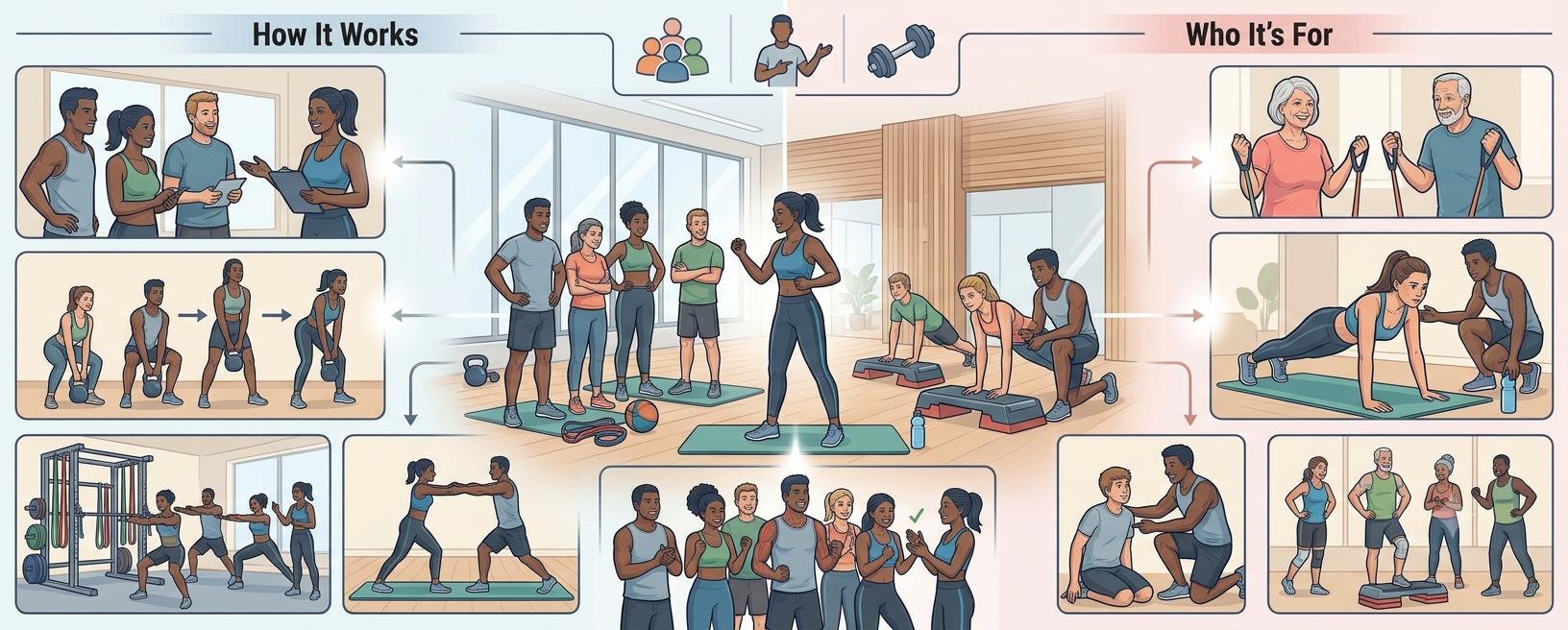
Small group personal training combines the benefits of personalized coaching with the motivation of working out alongside others. You train with a small group while a coach guides your technique, adjusts exercises to your needs, and helps you work toward your fitness goals.
It's a great option if you're looking for structured workouts, professional guidance, and a supportive environment without training alone.
Here's how small group training compares to other fitness options, what research suggests about group exercise, and how to decide whether it's right for you.
How Small Group Personal Training Compares
Small group personal training combines individualized coaching with the motivation and accountability of exercising alongside others.
The main difference between small group training, large fitness classes, and one-on-one personal training is the level of individual attention and exercise customization.
Why Group Training Helps You Stay Consistent
Staying consistent with exercise can be challenging, especially when you're training alone. It's easy to skip a workout or tell yourself you'll go tomorrow.
Group training adds structure, motivation, and a sense of community that can make it easier to maintain a regular fitness routine.
One frequently cited study published in the Journal of the American Osteopathic Association followed 69 medical students over 12 weeks. Participants who chose group fitness classes reported approximately a 26% reduction in perceived stress and improvements in quality of life, while those exercising individually reported no significant change in stress.
Because participants selected their own exercise format and the study involved medical students, these findings shouldn't be generalized to everyone.
However, the research suggests that group exercise may offer social and psychological benefits that support a positive fitness experience.
Small Group Training Isn't One-Size-Fits-All
A well-structured small group personal training session should accommodate differences in fitness levels, experience, mobility, and exercise technique.
Rather than having everyone perform identical exercises at the same intensity, coaches can modify movements and adjust training progressions based on individual abilities.
- If you're new to strength training: A coach can demonstrate movements, provide technique cues, and help you learn how to use resistance safely.
- If you're returning after a break: You may begin with lighter weights or simpler exercise variations before gradually progressing.
- If you already train regularly: Your coach can adjust resistance, repetitions, and exercise difficulty to match your current fitness level.
- If you have pain or a recent injury: Inform your coach before starting. A physical therapy assessment may be appropriate to determine which activities are suitable for you.
Squat technique is a great example of why individualized coaching matters. Learn more in our guide on how to improve your squat, which explores the role of ankle mobility, knee control, hip movement, and core stability.
Who Benefits From Small Group Personal Training?
Small group personal training can be a great fit for individuals who want professional coaching and structured workouts but prefer a shared training environment over traditional one-on-one sessions or large fitness classes.
It may be especially beneficial if you:
- Want structured workouts without the atmosphere of a large fitness class.
- Are looking to build strength and improve exercise consistency.
- Want professional coaching at a more accessible price point.
- Feel motivated by encouragement and accountability from others.
- Are starting a fitness routine or returning to exercise after time away.
With appropriate coaching and exercise modifications, small group training can accommodate a variety of ages, abilities, and experience levels.
Small Group Training After Physical Therapy
Completing physical therapy doesn't necessarily mean you've reached the end of your fitness journey.
Many individuals continue working toward goals related to strength, endurance, balance, mobility, and confidence after finishing their rehabilitation program.
Small group personal training may provide a structured environment to continue building strength and maintaining an active lifestyle.
However, the appropriate next step depends on your condition, recovery progress, and individual goals.
If you're still experiencing pain, limited mobility, or concerns about returning to exercise, speak with a physical therapist before joining a fitness program.
At Iron Health Physical Therapy, our orthopedic physical therapy services focus on individualized care to help patients improve movement and return to the activities they enjoy.
If you're transitioning from rehabilitation to regular exercise, ask your physical therapist whether small group personal training is appropriate for your needs.
Remember, group fitness is not a replacement for individualized rehabilitation or ongoing clinical care when it's needed.
Related reading: Who Is an Athlete? Explore why athletic activity can take many forms.
Frequently Asked Questions About Small Group Personal Training
What is small group personal training?
Small group personal training is a coached workout designed for a limited number of participants.
A trainer provides instruction, monitors technique, and adjusts exercises, resistance, or progressions based on individual needs.
Unlike larger fitness classes, small group training is designed to offer more personalized attention while maintaining the motivation of a group environment.
Is small group personal training good for beginners?
Yes. Small group personal training can be a good option for beginners when coaches provide clear instruction and appropriate exercise modifications.
It allows you to learn proper technique, build strength, and establish a consistent workout routine without having to plan every session yourself.
Be sure to communicate your fitness experience and any movement concerns to your coach before starting.
If you have ongoing pain or a significant injury, consider speaking with a physical therapist first.
Can I join small group training if I have an injury?
Possibly. Your ability to participate depends on the type of injury, your symptoms, and the exercises involved.
A coach may be able to modify certain movements, but small group training shouldn't replace an appropriate clinical assessment or rehabilitation program.
Always communicate your limitations and follow your physical therapist's recommendations when applicable.
Is small group personal training cheaper than one-on-one training?
Small group personal training is often more affordable per participant because the trainer works with several individuals during each session.
However, pricing varies depending on the provider, group size, session frequency, and program structure.
Contact Iron Health to learn more about current personal training options, pricing, and what's included.
Try Small Group Personal Training at Iron Health
Small group personal training offers a balance of professional coaching, structured workouts, and the motivation of exercising alongside others.
Whether you're new to strength training, returning to exercise, or looking for a more consistent fitness routine, the right program can help you build strength and confidence while staying accountable to your goals.
Before joining, consider your current fitness level, goals, schedule, and any movement limitations. If you're returning from an injury or completing rehabilitation, an individual assessment may be beneficial.
Ready to experience the benefits of small group personal training?
Contact Iron Health to learn more about our personal training programs at our Peekskill, Ardsley, and Briarcliff Manor locations.